
Introduction
Open any commercial door spec sheet and you'll find a line item most people skip past: the core. It's the internal material between the two steel or wood faces, and it controls nearly every performance trait that matters on the job.
Weight. Fire resistance. Sound control. Hardware support. Service life. All of it traces back to core construction.
Many facility managers and installers assume "hollow core" means empty or flimsy. That's rarely true. A honeycomb core, a steel-stiffened core, and a mineral core can all sit inside the same-looking door slab and behave completely differently under fire, impact, or daily abuse.
This guide covers the main commercial door-core types, clarifies where hollow construction ends and solid begins, and gives architects, distributors, and installers a clear way to match core to application.
Key Takeaways
- A door core is the internal material between the face skins, not the entire door assembly.
- Core type drives weight, strength, sound control, fire rating, and hardware compatibility.
- Common commercial cores include cellular/honeycomb, foam-insulated, steel-stiffened, solid wood/composite, and mineral.
- The right core depends on the opening's performance requirements, not just cost or familiarity.
What Is a Door Core?
A door core is the material or structure sandwiched between a door's two exterior faces, sometimes called face sheets or skins. It is distinct from the stiles and rails, top and bottom channels, and internal reinforcement plates used for hardware.
Think of the core as the door's skeleton and insulation combined. The face skins give it a finished appearance; the core gives it structure.
"Hollow core" is a misleading term. Few commercial hollow-metal doors are actually empty inside. Most use one of these lightweight strategies instead:
- Honeycomb or cellular paper structures bonded to both faces
- Rigid foam board, such as polystyrene, laminated between skins
- Steel stiffener sections running the height of the door
The same core category can still perform very differently depending on gauge thickness, skin material, and how the assembly is built and tested. Custom Metal Products offers polystyrene, polyurethane, temperature-rise, and steel-stiffened cores across its hollow-metal door lines, each to different gauge and reinforcement specifications.
Why Are Door Cores Important in Commercial Doors?
Core selection isn't cosmetic. It shapes how a door handles daily use and whether it can support the hardware and ratings the project requires.
Practical outcomes tied to core construction include:
- Door weight and ease of hanging, closing, and day-to-day handling
- Impact resistance from carts, gurneys, and heavy foot traffic
- Hardware retention for hinges, closers, locks, and exit devices
- Sound control between rooms
- Eligibility for a labeled fire-rated assembly
Get the core wrong, and problems surface fast. A lightweight cellular door under a heavy closer and exit device may work loose at the hinge within months. A door specified for a 90-minute fire rating without checking the labeled configuration may fail inspection entirely.
Under UL's guidance, the overall rating of a fire door assembly can never exceed the rating of its weakest labeled component, whether that's the door, frame, or hardware. Core material alone never guarantees performance—the complete tested assembly does.
Custom Metal Products builds reinforcement into its hollow-metal doors to limit those failure points. PH Series polystyrene-core doors, for example, ship standard with 7-gauge hinge pads, 10-gauge lock tabs, and 12-gauge closer reinforcements so heavy hardware stays anchored for the life of the opening.

Types of Door Cores
Door cores aren't interchangeable. A construction suitable for an interior architectural door may not hold up in a heavy-traffic hollow-metal opening, and vice versa. Here's how the major commercial types stack up.
Cellular or Honeycomb Core
A cellular core uses a repeating hexagonal or grid structure, typically kraft paper, bonded to both door faces. It fills the cavity without adding much weight.
Where it fits:
- Interior, light- to moderate-duty openings
- Cost-sensitive projects where budget outweighs heavy-duty performance
- Office corridors, closets, and low-traffic commercial doors
Strengths:
- Lighter weight makes handling and installation easier
- Lower material cost than solid or steel-reinforced options
- Adequate stability for basic interior use
Limitations:
- Reduced resistance to concentrated impact or abuse
- May need added reinforcement to support heavier hardware like exit devices
- Not typically suited to high-security or severe-duty environments
Before specifying, confirm whether the "honeycomb" listed in a spec sheet is genuinely cellular, tubular, or another lightweight configuration. Manufacturers don't build these identically, and duty ratings vary by product line.
Foam or Insulating Core
Foam cores use rigid insulating material, commonly polystyrene or polyurethane, laminated between the door faces. Manufacturers select this construction when reduced weight or improved thermal performance matters for the opening.
Custom Metal Products' PH Series uses a polystyrene core and reports a U Factor of .146 and R Factor of 6.87, along with an STC rating of 32 for the standard hemmed-edge configuration. Those are the kinds of tested numbers to request before assuming any foam-core door meets a thermal target.
Benefits to weigh:
- Lighter than steel-stiffened alternatives
- Insulation value relevant for exterior or temperature-sensitive openings
- Reasonable dimensional stability under normal conditions
Confirm before specifying:
- Whether the specific product is approved for exterior exposure
- Hardware reinforcement adequacy for the planned hinges and closers
- Fire-rating compatibility, since not every foam-core configuration carries the same UL listing
Steel-Stiffened or Reinforced Core
This construction uses internal steel channels or ribs, running vertically between the faces, to reinforce the door leaf. It's the go-to choice when a project needs more rigidity than a lightweight core can offer.
Custom Metal Products' SB Series illustrates the approach: 22-gauge hat-shaped stiffeners are spot-welded six inches on center to the face skins, with R-11 batt wool insulation filling the gaps between them.
That construction supports a maximum UL rating of 3 hours for select single and paired door configurations, compared to 1.5 hours for the polystyrene PH Series.
Typical settings:
- Schools and healthcare facilities
- Offices and service corridors with heavy foot traffic
- Industrial buildings where doors take repeated abuse
Trade-offs:
- Heavier than foam or cellular cores, which affects hinge and closer selection
- May require coordinated frame and hardware specification to handle the added weight
- Higher material cost than lightweight alternatives
Solid Wood or Composite Core
Architectural wood doors use several distinct core types, and the differences matter more than the umbrella term "solid core" suggests. According to the WDMA Door Glossary, particleboard cores are wood- or agricultural-fiber-based panels. Structural composite lumber uses bonded wood strands prized for strong screw-holding and split resistance.
Staved lumber cores, by contrast, use glued wood blocks or strips for a denser, more traditional feel.
Strengths across wood-core types:
- Substantial feel and impact resistance for high-use interior openings
- Strong hardware screw-holding, particularly with structural composite lumber
- Acoustic potential that often exceeds lightweight metal cores
Considerations:
- Heavier than cellular or foam cores, affecting hinge selection and handling
- Particleboard cores typically need added blocking at hardware locations
- Moisture exposure can affect dimensional stability over time
- Higher cost than basic cellular construction
Don't treat "solid wood core" as a single product. Ask which specific construction the manufacturer is quoting.
Mineral Core
A mineral core uses noncombustible or predominantly mineral-based material, selected when an opening needs a higher level of fire-resistance performance than standard wood or foam cores provide.
Mineral core doors can support labeled fire-rated openings, but the rating always depends on the complete tested assembly, including the frame, hardware, glazing, and seals, not the core material by itself. NFPA is clear that labeled fire doors and frames each carry separate ratings tied to their listing agency.
Potential strengths:
- Fire performance suited to higher-rated openings
- Dimensional stability under elevated temperatures
Limitations:
- Heavier than most alternatives, affecting hardware and frame selection
- May require internal blocking for specialized hardware attachment
- Handling and installation demands increase with weight
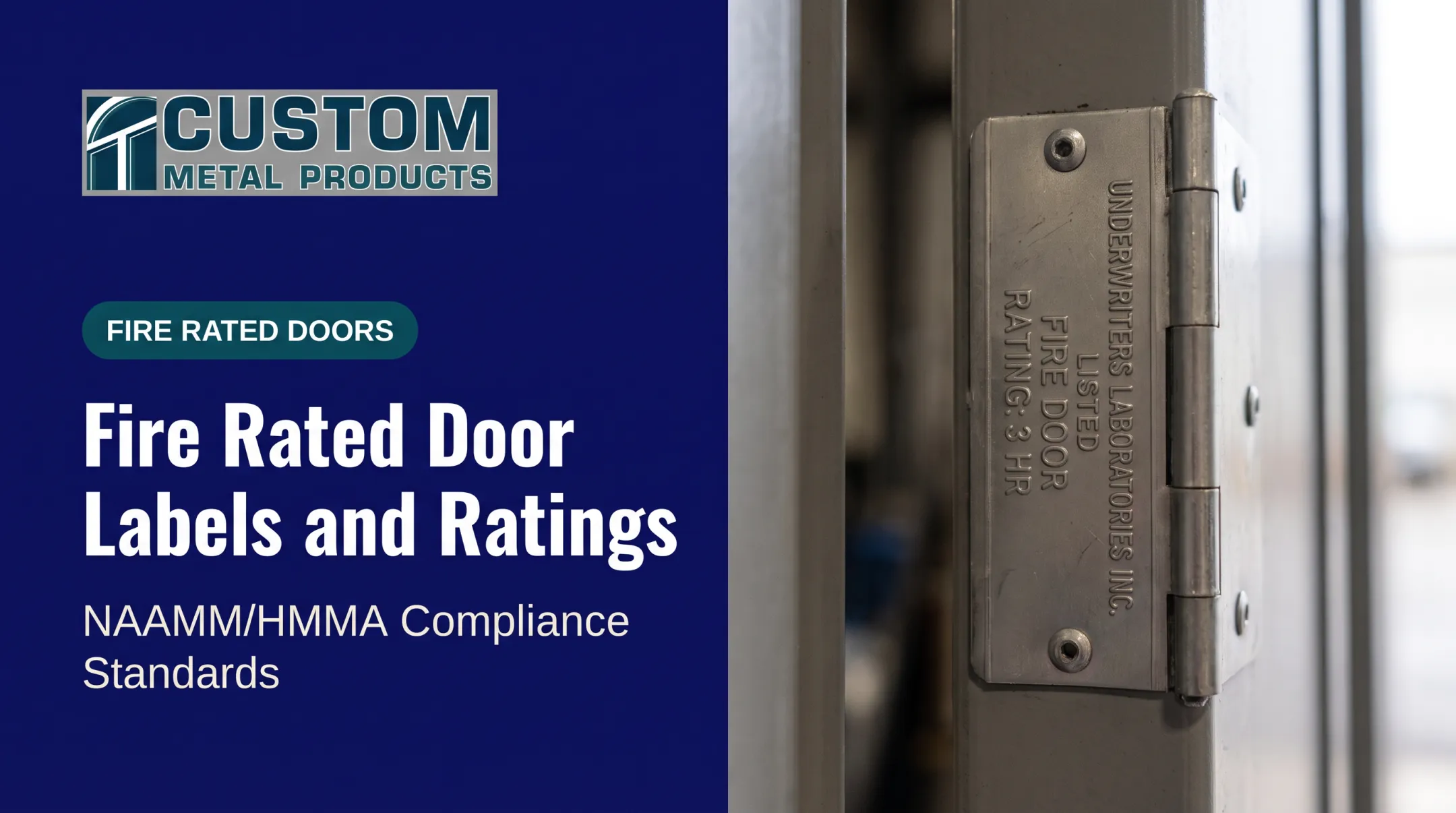
Custom Metal Products manufactures UL-labeled fire-rated hollow-metal doors and frames, following NAAMM/HMMA procedures for fire-rating compliance. Always confirm the exact approved configuration for your specific opening before ordering.

How to Choose the Right Door Core
The right core is the one that matches the opening's required outcomes, not the heaviest, cheapest, or most familiar option on the shelf.
Required Performance and Use
Start with the basics: traffic level, impact exposure, security needs, and whether the opening is interior or exterior. A back-of-house service corridor door has different requirements than a hospital patient room door, even if both look similar on paper.
Match the core and complete door construction to the project specification, occupancy classification, and any requirements from the authority having jurisdiction.
Confirm early whether the opening needs a fire label, temperature-rise performance, sound control, or insulation value. Don't assume a core material automatically delivers a rating.
Use current manufacturer test reports and listings instead. Custom Metal Products' PH Series, for example, documents an STC of 32 and a specific U-factor tied to its polystyrene construction. Compare those figures against your project's actual acoustic and thermal targets.
Hardware and Installation Coordination
Review the full hardware schedule (hinges, closers, locks, exit devices, and any electrified hardware) before locking in the core.
Confirm these before ordering:
- Required reinforcement and blocking for planned hardware
- Weight capacity of the frame and hinges relative to the finished door
- Installer capacity to safely handle and hang the selected leaf
Custom Metal Products preps exit devices, electric power transfers, and concealed closers to templated locations unless the project calls for something custom.
Budget, Lead Time, and Final Checks
Compare the sticker price against handling, installation, hardware, and long-term maintenance costs. A lighter core that saves money upfront may cost more in hardware repairs down the line.
Confirm availability and fabrication timelines early, especially for schedule corrections or time-sensitive projects. Custom Metal Products' standard door lead time runs 7 to 10 business days, with faster 1-, 2-, 3-, and 5-day programs available on select configurations. Direct-to-job-site delivery covers its eastern U.S. routes. Confirm exact timing for your specific door configuration rather than assuming a blanket lead time.

Don't default to a core just because it's familiar or labeled "standard." Every manufacturer defines that term differently.
Before finalizing:
- Verify what "standard core" actually means in the specific product line you're specifying
- Confirm trade-offs around fire performance, hardware support, and moisture resistance
- Obtain complete product data, labels, and approvals before placing an order
- Check that the door, frame, and hardware are compatible as one tested opening system
Conclusion
A door core shapes weight, strength, acoustics, insulation, fire performance, and hardware compatibility. Those traits all trace back to what's inside the leaf.
Cellular, foam, steel-stiffened, solid wood, and mineral cores each serve different project needs, and each comes with real trade-offs. None of them is universally "better."
Before specifying or ordering, compare the complete tested door assembly against your project's actual requirements. Lean on manufacturer documentation rather than assumptions.
Custom Metal Products works with architects, distributors, and installers to match core construction—from polystyrene to steel-stiffened—to the opening's real-world demands.
Frequently Asked Questions
Which is better, a hollow core or solid core door?
Neither is universally better. Hollow or cellular cores suit lightweight, cost-sensitive openings, while solid cores often provide greater durability, sound control, and hardware support. Match the core to the opening and the tested product specification.
What is a door core?
A door core is the internal material or structure between the two exterior faces. It contributes to the door's weight, strength, insulation, acoustics, fire performance, and ability to support hardware.
What is a standard door core?
There's no universal "standard core." The term typically refers to a manufacturer's baseline offering, which could be cellular, hollow, particleboard, or another construction. Always check the specific product data before assuming what "standard" includes.
What types of hollow cores are there?
Common lightweight constructions include honeycomb or cellular cores, tubular cores, and foam-filled cores. Performance varies by door design, face skins, reinforcement, and the manufacturer's testing.